
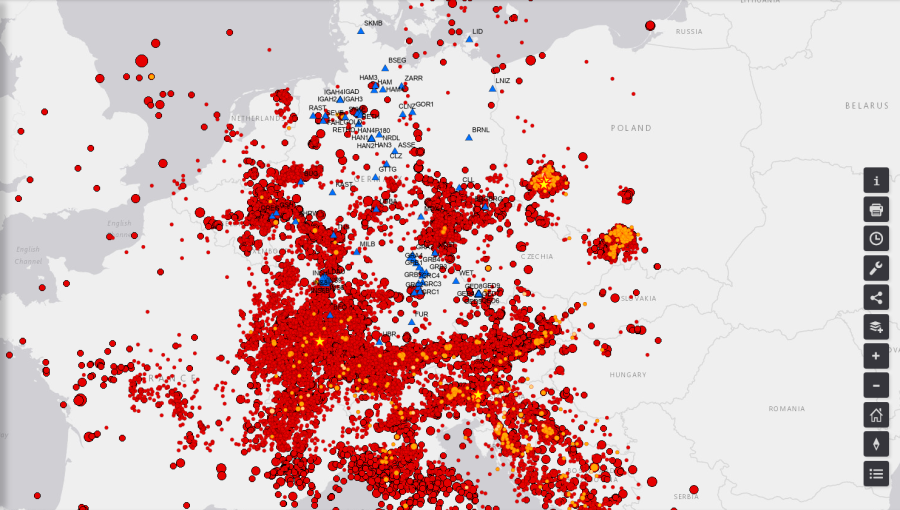
Sammlung von Erdbeben an verschiedenen Messstellen im mitteleuropäischen Raum. Die Aufzeichnungen reichen, sofern möglich, etliche Jahrhunderte zurück.
© Geoportal BGR, 27. Juni 2024
Protection against seismic events
The Earth’s crust – the solid ground beneath our feet – is often not nearly as stable as it feels to us humans. In fact, large and small fault zones and the associated stresses cause phenomena such as volcanic eruptions, the formation of mountain ranges and earthquakes. Although we in Germany are comparatively well protected from the forces of nature, natural seismic activity occurs regularly here too.
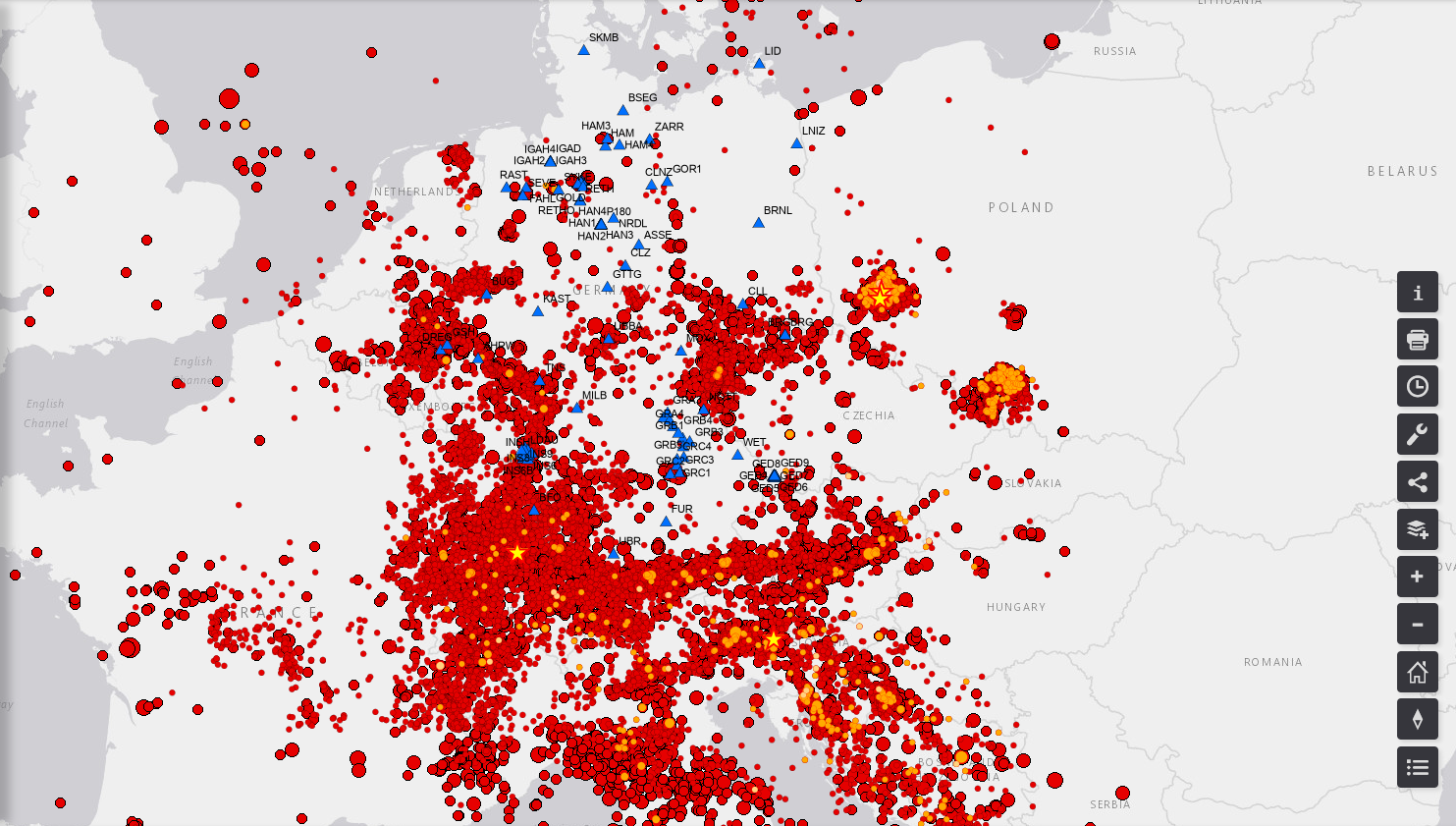
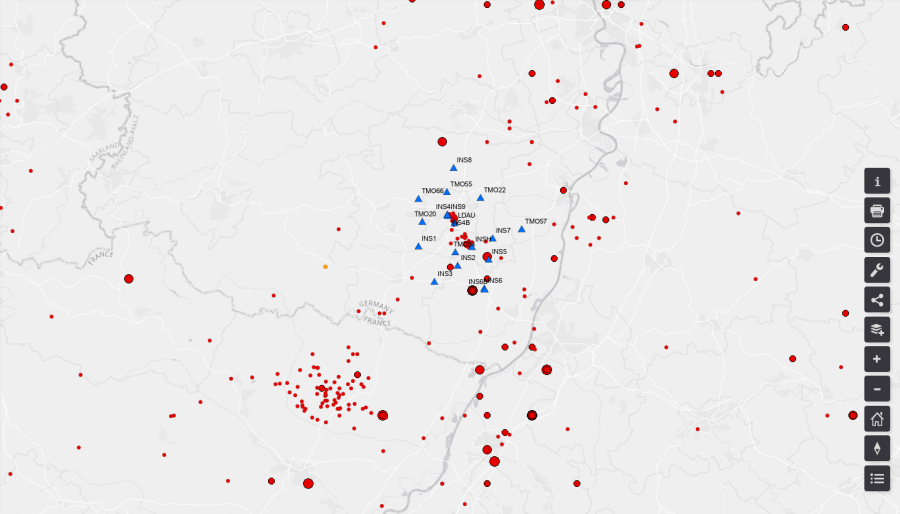
Deutscher Erdbebenkatalog für die Region um Kaiserslautern
© Geoportal BGR, 27. Juni 2024
Natural seismic activity
The Federal Institute for Geosciences and Natural Resources (BGR) geoportal records and displays natural seismic activity. The figure opposite shows a section of the Kaiserslautern region. Red dots represent events since the year 800, orange for events in the past year, light orange for events in the past month and yellow for the past week. Stars indicate recent events, whilst blue triangles denote seismometer stations where events are recorded. Clicking on the dots provides information such as the exact date, time, location, depth and magnitude of the earthquake, and the type of event (e.g. tectonic, induced). The diameter of the dots also indicates the strength of the earthquake.

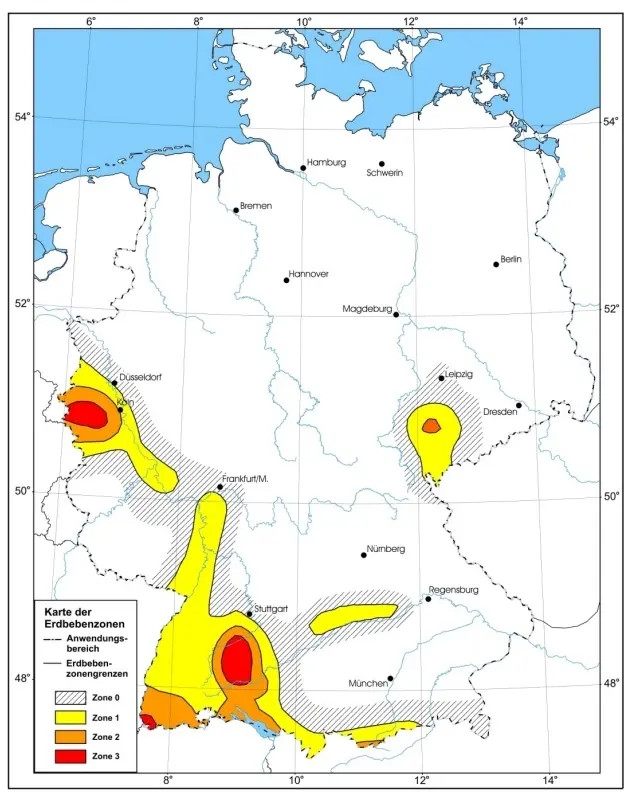
Erdbebenzonen in Deutschland
© GFZ
Induced seismicity
In addition to natural seismicity, there is also a form triggered by human activity, known as induced seismicity. As well as salt or coal mining, the injection of deep water can also trigger tremors if this leads to a sharp rise in pressure within the reservoir. Ideally, the returned deep water flows rapidly away from the end of the injection well, as is the case, for example, in larger fracture zones. However, in the case of less suitable injection targets, or if the production well delivers significantly more deep water than the injection well can accommodate and the system is not configured to match the flow rate at the injection well, stress can build up and be released in the form of fractures in the subsurface and associated ground movements.
Seismicity during the operation of a geothermal plant
Any direct or indirect activity within the deeper, solid rock of the Earth’s crust can trigger reactions in the rock in the form of ground movements, also known as seismicity or seismic events. The intensity – and therefore the perceptibility – depends on the strength of the ground movement. In the case of geothermal plants, seismicity has so far only occurred in connection with the injection of water into the subsurface. In order to identify critical zones in advance, various expert reports must be submitted and approved before drilling work begins.
To minimise the risk of seismic events during operation, both the pressure at the injection well and the vicinity of the geothermal plant are monitored using measuring stations. Some of the stations shown as blue triangles on the BGR map, for example, belong to the power station in Landau. If the injection pressure rises and/or minor ground movements are detected, measures such as reducing the production rate or even shutting down the plant are taken.