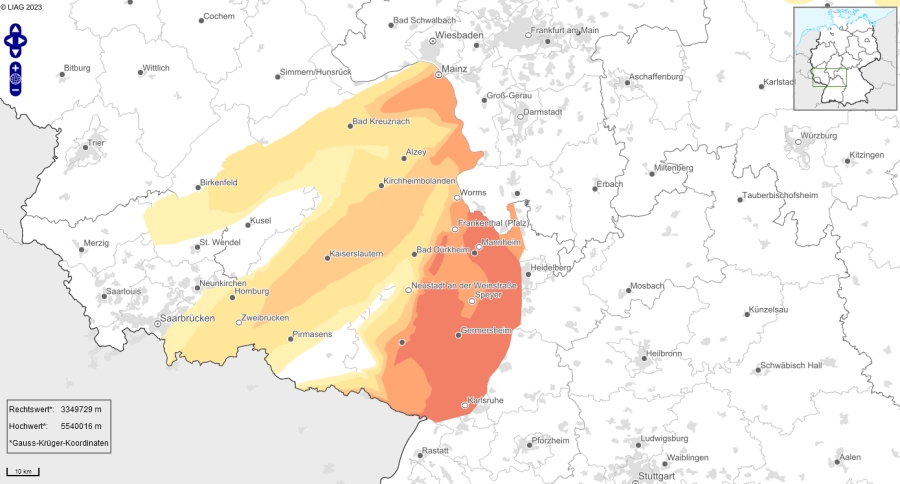
Vermutetes hydrothermisches Potenzial im Raum Kaiserslautern, abgebildet sind außerdem große Bruchzonen (schwarze Linien)
© LIAG
Seismic potential
From Riehen in Switzerland in the far south, via Bruchsal, to Landau, six plants here are harnessing a geological anomaly that produces particularly hot deep groundwater at relatively shallow depths. In addition to this enormous thermal potential, however, the Upper Rhine Graben is also known for its seismic potential, which stems from the numerous large fault zones in the subsurface and the build-up of stress that continues to this day.

The geothermal plant in Landau
Landau, situated around 50 kilometres from Kaiserslautern, lies in the Upper Rhine Graben. The first privately-run geothermal project was commissioned here in 2007; it was a pioneering project. In addition to the electricity generated by the first geothermal power station, the town also received renewable heat, which is now set to be further expanded.
The first borehole proved successful, producing 60 litres per second of deep water at 159 degrees Celsius. For the second borehole, with the authorities’ knowledge, high-pressure water stimulation was carried out for a week, which involved widening minor fracture zones in the subsurface. No significant seismic activity occurred during this process. During the first year of operation, the injection pressure rose sharply, leading in 2009 to seismic events with magnitudes of 2.7 and 2.4. This resulted in numerous reports of damage, mostly involving cracks in the plaster of buildings. Subsequent investigations were able to rule out geothermal energy as the cause in most cases. At the time of the first reports of damage, however, the operator had not yet taken out liability insurance, as is now standard practice for every geothermal project. Furthermore, since the amendment to the Federal Mining Act (BbergG), the so-called ‘reversal of the burden of proof’ has applied, meaning that the power station operator must prove that the damage was not caused by them. From a technical perspective, the injection pressure was reduced, which curtailed energy production. However, the second injection well originally planned was never drilled.
Another point of criticism that has dogged the Landau power station since it came into operation is its high noise level. This is due to the fact that, given the distance from the nearest residential area at the time, only minimal noise protection requirements applied; consequently, for example, no enclosure was fitted around the above-ground motor of the feed pump.
In 2014, the plant also had to contend with leaks, which were, however, successfully rectified. In this instance, deep groundwater escaping due to a lack of cementation in the uppermost section of the casing led to ground heave and damage, including to a railway line. This has since been rectified.
Despite the various challenges mentioned, geothermal energy has been officially pursued again in Landau since 2023, and the construction of a new plant is currently planned. These incidents have shaped the industry and brought about numerous positive developments. Kaiserslautern can now also benefit from this wealth of experience.
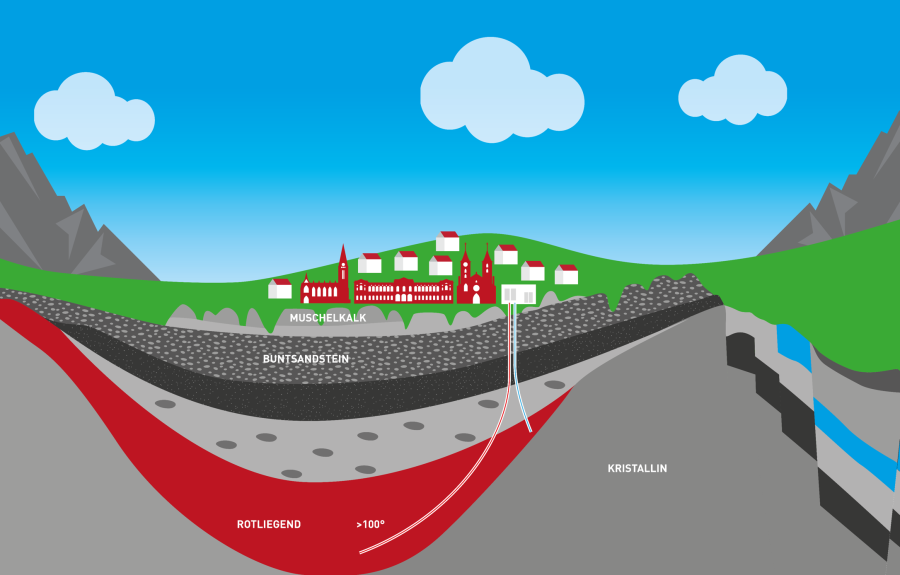
Schematische Darstellung des Rotliegend in der Pfälzer Mulde.
© Enerchange
Landau v Kaiserslautern
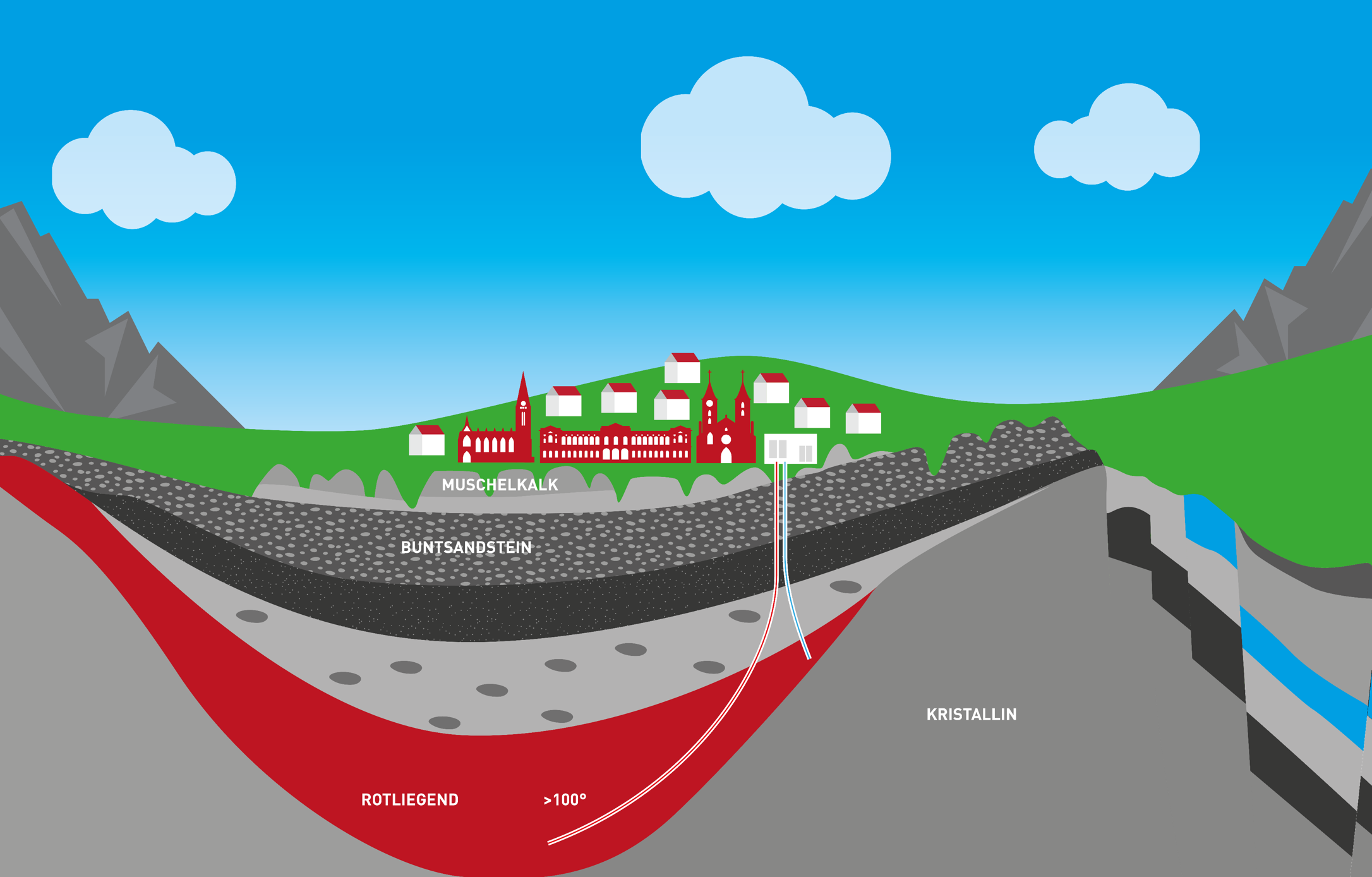
Unlike Landau, Kaiserslautern is not situated in the Upper Rhine Graben, but in the Palatinate Basin. There is less natural stress in this area and therefore a lower risk of seismic events. The drilling target is also different; we plan to tap into the Rotliegend, a naturally water-bearing sandstone layer, for hydrothermal geothermal energy. Furthermore, the Kaiserslautern project focuses on heat supply. Our aim is to make a long-term, regional heat source available to the residents of Kaiserslautern.