
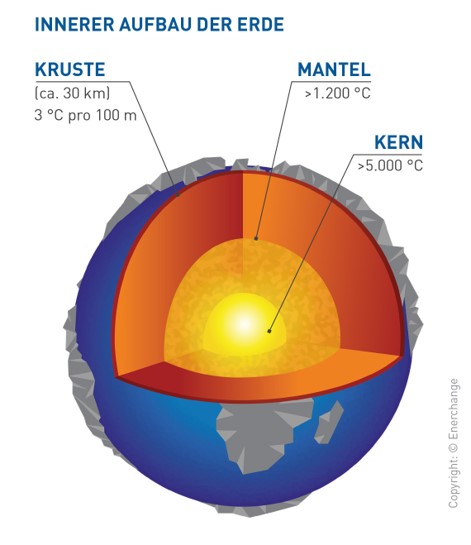
In Richtung des Erdkerns steigt die Temperatur stetig an.
© Enerchange
An inexhaustible source of warmth
Our Earth offers us an inexhaustible source of heat. This originates from the Earth’s interior, where temperatures exceed 5,000 degrees Celsius, and is renewable thanks to the constant decay of radioactive elements. Temperatures begin to rise steadily just a few metres below the Earth’s surface. This is known as the ‘geothermal gradient’. In Germany, this averages three to four degrees per 100 metres, meaning that a temperature of approximately 100 degrees Celsius can be expected at a depth of 3,000 metres. Depending on the location, the geological structure of the subsoil and the area of application, there are various ways of utilising geothermal energy. In addition to near-surface technologies, such as geothermal probes, which, when coupled with a heat pump, can supply individual buildings, larger-scale systems are also possible.
Hydrothermal geothermal energy utilises natural deep-water deposits found in porous and fissured rocks such as limestone or sandstone, and along fault zones. The hot deep groundwater can circulate here – in conjunction with the rock’s pore space, this is referred to as a reservoir. Using two boreholes – a production borehole and an injection borehole – the deep groundwater present in the reservoir can be brought to the surface. Here, it is cooled in a heat exchanger and transfers its heat to a secondary circuit (e.g. a district heating circuit) before being returned, otherwise unchanged, to the extraction layer. There, the deep groundwater is reheated.